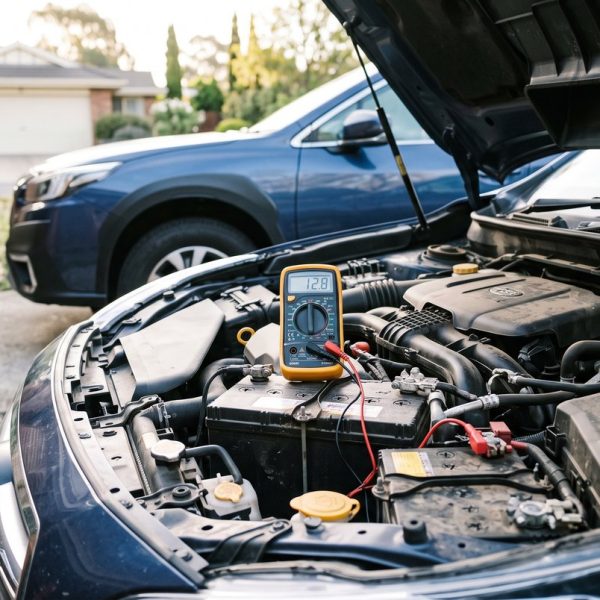
A car battery rarely dies without warning. It dies without a warning anyone noticed. The engine turned over a little slower last Tuesday, the headlights dipped when the blower came on, the stop-start system quietly stopped working, and none of it registered until a cold morning in a car park with somewhere to be. Learning how to test car battery health takes about three minutes and a tool that costs less than a tank of fuel, and it turns a roadside problem into a Saturday errand.
The three minute version with a multimeter
Set a digital multimeter to DC volts, twenty volt range. Red probe on the positive terminal, black on the negative. Do this with the engine off and ideally an hour or more after the car was last driven, because a battery holds a surface charge straight after a run and will read higher than it really is. If you are impatient, switch the headlights on for thirty seconds first to bleed that surface charge off, then switch them back off and measure.
Two other readings are worth taking while you are there. Have someone crank the engine while you watch the meter: a healthy battery should not dip below roughly 9.6 volts during the start. Then let the engine idle and measure again. You should see somewhere between 13.7 and 14.7 volts, which tells you the alternator is charging. A reading that stays near 12.5 with the engine running points at the charging system rather than the battery.
What the car battery voltage numbers mean
The scale is narrower than most people expect, which is why guessing does not work. About 12.6 volts or a little above is a fully charged battery. Around 12.4 volts is roughly three quarters charged. Around 12.2 volts is half, and anything at or below 12.0 volts is effectively flat even though the number still looks close to twelve. A tenth of a volt matters here in a way it does not anywhere else on the car.
Those figures assume a conventional lead acid unit, which is still what sits under most bonnets. The chemistry is old, well documented and unforgiving about being left partly discharged, and the overview of the lead acid automotive battery is worth a skim if you want to understand why a flat battery that sits flat for a fortnight often never fully recovers.
Testing without a multimeter
You can learn a surprising amount without any tools. Start the car at night with the headlights on and watch them: a noticeable dim during cranking that recovers once the engine catches is normal, but lights that stay dull at idle are not. Listen to the starter. A slow, laboured turn, or that rapid clicking that means the solenoid is getting voltage but not current, both point the same way. On newer cars, a stop-start system that has silently stopped shutting the engine off at traffic lights is often the first honest symptom, because the car monitors battery state and disables the feature to protect it.
Most chain parts shops will test a battery free in the car park, and their load testers give a better picture than a voltage reading alone. If you would rather sanity check a symptom before spending anything, the mechanics who answer questions on r/MechanicAdvice are generally good at separating a dying battery from a parasitic drain.
How long does a car battery last
Three to five years is the usual honest answer, and where you live moves that number more than how you drive. Heat is the real killer. Sustained high under-bonnet temperatures accelerate the internal corrosion that eventually kills capacity, so batteries in hot climates often give up around the three year mark while the same unit in a mild one reaches six. Cold does not damage a battery so much as expose one that was already weak, which is why so many fail on the first genuinely cold morning of the year.
Short journeys shorten life too. A five minute trip to the shops takes more out of a battery starting the engine than the alternator puts back before you switch off, and a battery that lives permanently at eighty percent charge sulphates and loses capacity. If that describes your driving, a cheap trickle charger once a month is the single most effective thing you can do.
When the battery light on in car is not the battery
The dashboard battery symbol is one of the most misread warnings on the car. It does not mean the battery is flat. It means the charging system is not delivering the voltage it should, which usually implicates the alternator, its belt or the wiring between them. Replacing a perfectly good battery because that light came on is a common and expensive mistake. Test first, then decide.
The same logic applies to most wear items on a car: measure, then spend. Brakes are the obvious companion case, and knowing the realistic brake pads replacement cost before you walk into a garage changes the conversation considerably.
One last point that matters if you drive an imported car or a model sold across several markets. Owner handbooks and service documentation are translated, and the quality of that work varies. A torque figure or a charging specification that reads oddly is worth checking against the manufacturer original, and the case for professional technical translation in the automotive world is largely built on exactly these small numbers being right.
Accuracy in translated technical documentation is not just a nice-to-have; it is a safety issue when torque specs and voltage ratings are involved. Manufacturers and importers rely on technical translation services that employ subject-matter experts familiar with automotive terminology. A mistranslated specification can lead to incorrect maintenance or even component failure. Professional technical translation protects both the driver and the manufacturer from costly errors.
None of this requires mechanical talent. It requires ten minutes, once a season, before the weather turns.